Showing posts with label Wiki. Show all posts
Showing posts with label Wiki. Show all posts
Sunday, March 30, 2008
Enterprise Wiki - Why and How to Start One
Mike Cannon-Brookes has a good presentation on Organisational Wiki Adoption on SlideShare (link via DavidRothman.net). This may convince your department or hospital to start a wiki, if you do not already have one.
He also lists the top 4 wiki enemies:
1. Share drives
2. Email
3. Knowledge management
4. Intranets

Monday, June 18, 2007
Web 2.0 in Medicine Presentations by a University of Michigan Librarian
Using RSS Personally and Professionally
Staying Current with Science Blogs & Wikis
The author of both presentations is Patricia Anderson. She is a Head Librarian for the Dentistry Library of the University of Michigan, Ann Arbor and has collected more Web 2.0 presentations on SlideShare.
Link via David Rothman.
Further reading:
Best Web Feeds Reader for Medical and General Information
RSS in Plain English -- The Best Video Explanation in 3 Minutes
PubMed RSS feeds are now live
Get RSS Feeds for Any Medical Journal from Pubmed
Collaborative Presentation on Web 2.0. Link via Go2Web2.
Web 3.0 Concepts Explained in Plain English (Presentations). Digital Inspiration, 2009.
Updated: 06/02/2009
Thursday, June 7, 2007
Medical Encyclopedia AskDrWiki Expands Collection of Videos and Images
 AskDrWiki is a collaborative encyclopedia started by cardiology fellows at Cleveland Clinic which is expanding rapidly its scope of high quality free content. The project received a lot of coverage from both professional and mainstream media which had the desired effect of bringing more contributors. A wiki is only as good as its contributors and there is definitely a strength in numbers. In addition, the AskDrWiki founders have introduced a rigorous screening process to ensure that only qualified medical professionals can add and edit articles. My application was accepted and I am currently a member of the Editorial Board.
In the recent months, AskDrWiki has expanded its collection of free medical videos and images:
- Echocardiograms - 177
- Coronary Angiograms - 145
- Peripheral Angiograms - 26
- EKGs - 76
Physicians in training interested in cardiology may find the step-by-step video tutorials of Coronary Angiography and Ventriculography especially valuable.
In summary, AskDrWiki seems to be an exciting medical education project which brings good quality content online (for free) and I am happy to be a small part of it.
Ken Civello, Brian Jefferson and I have presented abstracts about using the wiki for different aspects of medical education at several local, national and international scientific meetings where the posters brought a lot of interest and lively discussion.
Wednesday, May 9, 2007
StudentBMJ Mentions ClinicalCases.org in an Article About Online Medical Information
 Our project Clinical Cases and Images - A Case-Based Curriculum of Clinical Medicine (ClinicalCases.org ) was mentioned in the May 2007 issue of StudentBMJ: Trust me; trust me not. The article discusses trustworthiness of online medical information including new Web 2.0 tools such as wikis and blogs.
Dean Giustini, who is one of the best Web 2.0 experts among librarians, was very kind to mention our project in his interview with the author:
"...the main boon of Web 2.0 is how it allows medical practitioners to communicate more effectively with each other. When doctors talk to each other, he says, "The discussions that they have together actually create knowledge-they're continually teaching each other."The technologies of Web 2.0 can allow these conversations to become more fluid, resulting in a "continual process of sharing, information, and repurposing information."Such a process might be facilitated by a wiki, by a medical blog containing clinical information, such as Clinical Cases and Images (http://clinicalcases.blogspot.com), or by a blog recording the thoughts and activities of an individual clinician, such as the popular NHS Blog Doctor (http://nhsblogdoc.blogspot.com)."
The StudentBMJ has a RSS feed with an additional nifty feature: a mash-up box which allows you to create a custom RSS feed from the journal content which fits your search criteria.
References:
Trust me; trust me not. Christopher Hands, studentBMJ 2007;15:169-212 May.
Librarianship and Handling the Media. Dean Giustini, UBC Academic Search - Google Scholar Blog.
Image source:
StudentBMJ.
Sunday, April 22, 2007
A List of Medical Wikis
 David Rothman has assembled a comprehensive list of medical wikis which seems to be growing longer every day. He will need to reorder them in categories soon.
If you click through the entries on the list, you will notice that many wikis are still in early stage with just a few entries. Many of them will not make it and will eventually fade into oblivion. It is a normal process similar to natural selection. The most popular wikis (with most contributors/readers) will survive.
We have discussed several times with the founders of AskDrWiki that the main challenge for a wiki manager is getting people to contribute. Doctors are busy and few of them have time (and desire) to create quality content for free.
The WSJ Mossberg Solution includes an article about Creating Your Own 'Wiki' Web Site.
Mike Cannon-Brookes has a nice presentation on Organisational Wiki Adoption on SlideShare (link via DavidRothman.net). This may convince your department or hospital to start a wiki, if you do not already have one.
Wikis in Plain English
References:
Why don't more doctors blog? Kevin, MD.
Medical Wikis Proliferate. John Sharp, eHealth.
Which Wiki is Right for You? School Library Journal, 5/1/2007.
WiserWiki was originally seeded with content from John Noble’s “Textbook of Primary Care Medicine” (3rd Edition) provided by Elsevier.
Image source: Arik Baratz, Wikipedia, Creative Commons.

Updated: 01/07/2008
Thursday, April 5, 2007
Web 2.0 in Medicine Presentations at Research ShowCASE in Cleveland
 The cleverly named 5th annual Research ShowCASE at Case Western Reserve University features at least 3 presentations on using Web 2.0 technologies in medicine:
- Blogs: Use of a Free Blog Service to Build a Web Site for a Hospitalist Group
- Wikis: Use of a Wiki-based Web Site for Medical Education
- Sharepoint: Web-based Collaboration for Clinical Care, Research and Education at an Academic Hospitalist Group
I am a co-author along with John Sharp, Ashish Aterja and Neil Mehta from Cleveland Clinic, and Ken Civello and Brian Jefferson from AskDrWiki (which was also started at the Clinic).
As you can see, we pretty much cover a lot of the spectrum of Web 2.0 in medicine with abstracts on blogs and wikis but some unexplored topics still remain: web feeds (RSS/Atom), podcasts, video-sharing sites (YouTube/Google Video), photo-sharing sites (Flickr/Picasa Web), social media (Sermo).
With all the recent coverage that AskDrWiki received from the press, wikis seem to be all the rage, displacing blogs from the top spot in the short attention span of the general media. I think wikis offer much more opportunities for medical education than blogs because by design they are open, multi-author communities. Most blogs are still more or less a "one-man-show." Believe it or not, blogging is becoming old news and seems to have "matured" since 2004. This is confirmed by the Tecnorati's State of the Blogosphere annual report which shows that blog posts per day, the most critical measure as it relates to blogging, slid. Micro Persuasion provides more coverage in As Daily Postings Slide, Blogging Peaks.
Don't get me wrong, I still think that blogs are incredible tools for medical education which are extremely easy to use and can reach millions in a matter of seconds after hitting the "publish" button. If you have doubts, just check my SiteMeter statistics with 1,310,750 page views since 2005. Still, I am becoming more interested in wikis especially since I have discussed their use with AskDrWiki founders.

One of the main reasons why we submit abstracts to Research ShowCASE and other national meetings is the goal to make medical educators aware of the exciting opportunities that Web 2.0 technologies offer.
If you are in Cleveland on April 12, please come to join us at Research ShowCASE. You may have the chance to meet some real celebrities - Ken and Brian of AskDrWiki were featured on the front page of the main Cleveland newspaper The Plain Dealer last week.
My presentation on Web 2.0 in Medicine from December 2006.
References:
Upcoming Presentation at Research Day at Case Western Reserve University. eHealth, John Sharp, 4/5/2007.
Main Cleveland Newspaper Features a Cleveland Clinic-based Wiki
As Daily Postings Slide, Blogging Peaks. Micro Persuasion, April 05, 2007.
Wikis, blogs and podcasts: a new generation of Web-based tools for virtual collaborative clinical practice and education. BMC Med Educ. 2006; 6: 41.
Images source:
Case Western Reserve University campus, Wikipedia, GNU Free Documentation License.

Terminal Tower in Cleveland, photo by Lisa Chamberlain, Wikipedia, Creative Commons Attribution ShareAlike 2.0 License.

Further reading:
Collaborative Presentation on Web 2.0. Link via Go2Web2.
Social media in medical education - Grand Rounds presentation by IUH Med/Peds residency program director http://goo.gl/Zw3lK
Saturday, March 31, 2007
Main Cleveland Newspaper Features a Cleveland Clinic-based Wiki
 The Plain Dealer is the major newspaper in Cleveland and we are lucky to have Pulitzer-winning journalists writing for it. I especially enjoy the Friday section which lists many "things to do" for the weekend: festivals, museums, etc.
On Thursday, the front page of The Plain Dealer featured AskDrWiki, a medical wiki created by 4 cardiology fellows at the Cleveland Clinic. I know Ken Civello and Brian Jefferson and I think that they are incredibly bright and have a great future in front of them.
The medical wiki in question has unique, high-quality content, for example, more than 90 free videos of cardiac catheterizations. I can see web sites like AskDrWiki, maintained by experts, becoming competitors to UpToDate and other paid resources. UpToDate is useful but it charges "an arm and a leg" for individual subscriptions. Few companies can compete with free, if the quality is comparable. Look what happened to the once mighty encyclopedia Britannica -- it is gradually becoming irrelevant, out shined by the ever growing Wikipedia.
Medical wikis have several limitations to overcome to be recognized as trustworthy, and we have discussed them many times with Ken and Brian. They have one quality which likens them to Sergey Brin and Larry Page of Google - they attentively listen to requests and advice by users. For example, after David Rothman suggested a tighter control on who can edit the wiki, Ken and Brian introduced registration to insure that only medical professionals are registered as contributors. This is just on of the many problem solutions along the way of making medical wikis mainstream but it is a step in the right direction.
I do stay by my quote in The Plain Dealer article: "Sites like AskDrWiki will change the way we study and teach medicine."
For additional coverage (positive and negative) of AskDrWiki, please check:
Ask Dr Wiki vs medicine in Wikipedia.ScienceRoll.
Cleveland Plain Dealer on Medical Wikis. DavidRothman.net.
My own opinion is here: Medical Wikis May Change the Way We Study Medicine
Ken, one of AskDrWiki founders, started a blog which he will use to post announcements about the wiki, and most importantly, to ask for feedback from you -- students, physicians, nurses and general readers of medical blogs. Please welcome Ken to the medical blogosphere and Grand Rounds. He definitely has something interesting to say. Featuring interesting EKGs of the week doesn't hurt either.
References:
Same excuses. DavidRothman.net.
Medical wikis: the future of medicine? ScienceRoll.
Medscape interview w/ Bertalan Meskó (Medical Wikis) ScienceRoll.
Technology for the rest of us: Easy to use wikis. Tobias Buckell, BloggingStocks.
Image source: DavidRothman.net, The Plain Dealer.
Saturday, January 27, 2007
Medical Wikis May Change the Way We Study Medicine
A wiki is a web site which allows the visitors themselves to easily add, remove, and otherwise edit available content. The most famous wiki-based projects is Wikipedia, the world-largest free encyclopedia with more than 1.5 million English-language articles, which can be edited by anyone. Few studies have explored the effect of this new medium on medical education.
AskDrWiki by Cleveland Clinic Cardiology Fellows

Quite a few things have happened since the last time I wrote about AskDrWiki:
- I emailed Dean Giustini about AskDrWiki and he referenced the site in his landmark BMJ editorial How Web 2.0 is changing medicine
- I met the wiki editor, Ken Civello, who is an electrophysiology fellow at the Cleveland Clinic and a really smart guy
- Both Ken and I wrote the abstract "A Wiki-based Web Site as an Educational Tool for Cardiology Fellows" which will be presented at the meeting Medical Education for the 21st Century at the Case Western Reserve University School of Medicine Annual Education Retreat on February 8, 2007. I like this line the best: "The pockets of your lab coat are only so big and what you remembered last month, you may not remember next year. The ability to have access to the "collective online memory" of a fellowship program may help fellows enhance their education, and ultimately, provide better patient care." I will upload the poster here next week.
In the meantime, Ken and his collaborators have added some useful new features to AskDrWiki:
- Videos of Coronary Angiograms which are now searchable on Google Video
- Videos of Echocardiograms
- EKGs
JTF (Just the Facts) Wiki at the University of Michigan

JTF (Just the Facts) Wiki is a "Manual for the Interns Online" by medical students and residents at the University of Michigan and Ann Arbor VA Hospitals. The manual was started in 1991 and is in its 13th edition (?!) now. JTF has a well-done procedure section and some good videos of central line placement which I will upload in a separate post.
Summary
I think medical wikis will change the way we study and teach medicine. In the foreseeable future, their role is not in creating "the most authoritative textbook" ever but rather in creating a "collective online memory" for a group of learners. Where these new web tools will lead us in the future, as usual, nobody knows, and this is the beauty of the amazing medium that the Internet is.
Mike Cannon-Brookes has a nice presentation on Organisational Wiki Adoption on SlideShare (link via DavidRothman.net). This may convince your department or hospital to start a wiki, if you do not already have one.
Wikis in Plain English
References:
Wiki from Wikipedia, the free encyclopedia.
AskDrWiki -- A Collaborative Medical Encyclopedia
Do We Need a Free Medical Encyclopedia?
Which Wiki is Right for You? School Library Journal, 5/1/2007.
Elsevier’s WiserWiki. DavidRothman.net, 11/2007.
Medpedia Project from Harvard Medical School.
Further reading:
Web Watch: Living in the brave new world of medical wikis. ACP Internist, 01/2008.
ACP Internist on Medical Wikis. DavidRothman.org, 01/2008.
Updated: 01/12/2008
Monday, January 1, 2007
AskDrWiki -- A Collaborative Medical Encyclopedia
AskDrWiki.com is a medical encyclopedia based on a wiki platform. The authors were one of the first to use YouTube to upload medical videos. Dean Giustini and I discussed this fact a few weeks ago, and he wrote about it in his landmark BMJ editorial How Web 2.0 is changing medicine, linking to AskDrWiki.com.
Coronary Angiograms: Coronary Dissection
Ganfyd is another medical Wiki community, created in November 2005 by a group of doctors working in the UK. It is intended to become a large on-line textbook of medicine (source: Wikipedia).
Graham shares his concerns about medical wikis in his post "I Will Never Trust Dr. Wiki… because I will never trust malicious teenagers."
Mike Cannon-Brookes has a nice presentation on Organisational Wiki Adoption on SlideShare (link via DavidRothman.net). This may convince your department or hospital to start a wiki, if you do not already have one.
Wikis in Plain English
References:
Do We Need a Free Medical Encyclopedia?
British Medical Journal Features Clinical Cases and Images - Blog, Again
I Will Never Trust Dr. Wiki… Grahamzon.com.
Medical wikis. DavidRothman.net.
Lots More Medical Wikis. DavidRothman.net.
Updated: 10/03/2007
Saturday, December 9, 2006
Edit Wars in Medical Wikipedia
 Background
Wikipedia uses the "wisdom of crowds" concept which postulates that scores of non experts do a better job writing an article than a single expert. It is probably true. Most experts are busy people and do not have time to write, edit and protect from vandals more than one million articles.
Any social media website (and Wikipedia is one of them) has a relatively small number of devoted users who keep the project going and do the bulk of contributions. For Wikipedia, these users are about 500 and they are called administrators. They are in charge of keeping the encyclopedia what is supposed to be -- an encyclopedia -- and not a self-promotion tool.
What happens when administrators disagree with regular contributors? Edit war. There are revisions and versions changed back and forth until sometimes users are even locked-out of "Wikipedia land."
How is this related to medicine?
According to a recent Medscape editorial, "Wikipedia is the future of medicine, and it's good." There is a Clinical Medicine project on Wikipedia which one day may become the most comprehensive medical textbook. Dean Guistini of UBC Academic Search - Google Scholar Blog also started a wiki at University of British Columbia.
I was reading the Wikipedia article about Polycythemia and since I had an illustrative typical case of secondary polycythemia on ClinicalCases.org, I decided to add it in the "External Links" section at the bottom of the page. That was a well-intentioned and innocent addition, I thought. One of the administrators, JFW, disagreed, called my little effort "advertisement" and deleted the link. We discussed it at the talk page and since I tremendously respect people who take care of the world's largest encyclopedia (for free), I just moved on.
Some people are tougher to deal with though. One hair-transplant surgeon is having fierce fights on his talk page regarding his contributions to Wikipedia which are dubbed by some administrators "commercial" and "promotional." If you have 4-5 minutes, I would recommend reading the whole page to get a feel of what an edit war looks like:
Administrator:There is (was?) also a Wikipedia page about one of the medical bloggers, Summer Sethi, which was labeled for deletion as a "vanity page":
Welcome to Wikipedia. We invite everyone to contribute constructively to our encyclopedia. Take a look at the welcome page if you would like to learn more about contributing. However, unconstructive edits, such as your changes to the Raymond V. Damadian page, are considered vandalism, and if you continue in this manner you may be blocked from editing without further warning. Please stop, and consider improving rather than damaging the hard work of others. Thank you. Talk: Administrator.
Plastic surgeon:
Unconstructive edits, vandalism? nonsense. The page on Raymon V Damadian contains numerous factual errors and much evident confusion about the technology which I was just attempting to correct. I'm and MD PhD who was there when all this stuff was going on. Even published papers in the field and know many of the princopals. See my comments at. Talk:Raymond V. Damadian.
Strong delete: Wikipedia is not a resume or publication list. There are perhaps thousands of other medical researchers with similar publications, nothing shows why this person is any more notable than them. --Ragib 23:59, 2 September 2006 (UTC)The Full-body scan article is another example of a disagreement between contributors and administrators.
A fine line
Administrators like JFW and Samir are the backbone of the Clinical Medicine project in Wikipedia. Their job is to keep the vandals and self-promotion types out of the encyclopedia. If you make contributing too difficult though, "regular guys" may just go somewhere else.
Wikis in Plain English
References:
Who Edits Wikipedia? Philipp Lenssen.
Raw Thought: Who Writes Wikipedia? Aaron Swartz.
Wikipedia:Lamest edit wars, via Yahoo picks.
Make the Largest Encyclopedia in the World Better. I already did (I hope)
Related:
Why Slate is Wrong About “the myth of Web 2.0 democracy” DavidRothman. net, 02/2008.
Wikipedia: A Key Tool for Global Public Health Promotion (review article)
Sunday, November 5, 2006
DPP-4 Inhibitors for Treatment of Diabetes
Glucagon-like peptide-1 (GLP-1) is a GI peptide that stimulates insulin secretion (similar to sulfonylureas). GLP-1 also inhibits glucagon release, gastric emptying and food absorption. GLP-1 and another similar peptide are called incretins. As noted above, incretins have a dual action which leads to lowering blood glucose:
1. Stimulate insulin release
2. Inhibit glucagon release
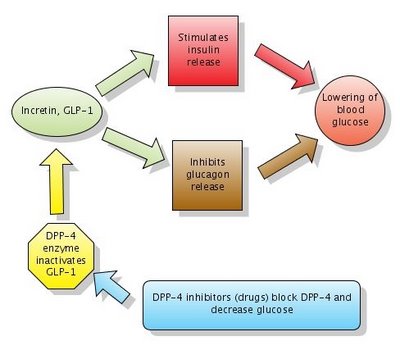
Figure 1. Action of DPP-4 inhibitors. Note that DPP-4 normally inactivates GLP-1. DPP-4 inhibitors block DPP-4 which in turn leaves GLP-1 active. Click to enlarge the figure. Created with Gliffy. The diagram Action of DPP-4 inhibitors is now on Wikipedia.
Exenatide (Byetta) is a GLP-1 receptor agonist approved for adjunctive therapy for patients with DM 2 who are not well controlled on oral agents. It is available only as injections and has to be administered twice daily.
Two new medications increase GLP-1 levels by blocking the enzyme which inactivates GLP-1. The enzymes is called DPP-4 (dipeptidyl peptidase-4) and the new medications are called DPP-4 inhibitors or gliptins.
They act similarly to Byetta (see figure above) but have the big advantage to be available in oral form (pills). These 2 new medications for treatment of DM2 are:
- Sitagliptin (Januvia) is taken once a day and it costs about $ 4.50 per pill
- Vildagliptin (Galvus) is waiting for FDA approval but it is already speculated to be at a competitive disadvantage to Januvia because it has to be taken twice a day
References:
New Medications
Merck Wins U.S. Approval for a New Diabetes Drug. NYTimes.
Sitagliptin: First DPP-4 Inhibitor for Type 2 Diabetes. Resident and Staff Physician, 04/2007.
Merck Diabetes Drug Could Face Competition from Takeda. WSJ Health Blog, 01/2008.
Related:
Lilly, Amylin Disclose More Cases of Byetta-Related Pancreatitis. WSJ Health Blog, 08/2008.
FDA Issues Warning for Diabetes Drug Byetta about possible kidney problems, including renal failure http://bit.ly/1UOjwB
Updated: 11/03/2009
1. Stimulate insulin release
2. Inhibit glucagon release
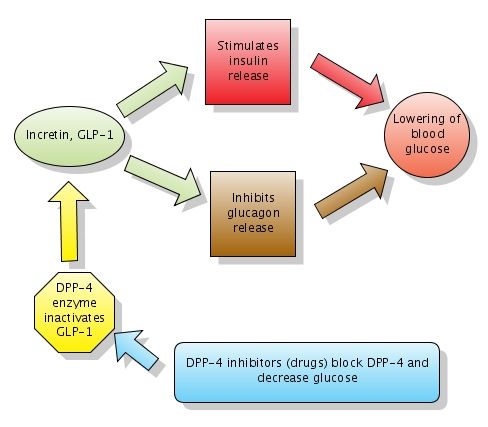
Figure 1. Action of DPP-4 inhibitors. Note that DPP-4 normally inactivates GLP-1. DPP-4 inhibitors block DPP-4 which in turn leaves GLP-1 active. Click to enlarge the figure. Created with Gliffy. The diagram Action of DPP-4 inhibitors is now on Wikipedia.

Exenatide (Byetta) is a GLP-1 receptor agonist approved for adjunctive therapy for patients with DM 2 who are not well controlled on oral agents. It is available only as injections and has to be administered twice daily.
Two new medications increase GLP-1 levels by blocking the enzyme which inactivates GLP-1. The enzymes is called DPP-4 (dipeptidyl peptidase-4) and the new medications are called DPP-4 inhibitors or gliptins.
They act similarly to Byetta (see figure above) but have the big advantage to be available in oral form (pills). These 2 new medications for treatment of DM2 are:
- Sitagliptin (Januvia) is taken once a day and it costs about $ 4.50 per pill
- Vildagliptin (Galvus) is waiting for FDA approval but it is already speculated to be at a competitive disadvantage to Januvia because it has to be taken twice a day
References:
New Medications
Merck Wins U.S. Approval for a New Diabetes Drug. NYTimes.
Sitagliptin: First DPP-4 Inhibitor for Type 2 Diabetes. Resident and Staff Physician, 04/2007.
Merck Diabetes Drug Could Face Competition from Takeda. WSJ Health Blog, 01/2008.
Related:
Lilly, Amylin Disclose More Cases of Byetta-Related Pancreatitis. WSJ Health Blog, 08/2008.
FDA Issues Warning for Diabetes Drug Byetta about possible kidney problems, including renal failure http://bit.ly/1UOjwB
Updated: 11/03/2009
Thursday, October 12, 2006
A Nephrology Wiki
 The Nephron Information Center which started the wiki is "not connected to the Wikipedia Foundation, but uses the same software. The Center was founded in 1996 by Dr. Fadem as a public service."
This Nephrology Wiki includes:
1 Kidney Resources - NIC
2 Especially for Patients
3 General Kidney Resources
4 Issues in Nephrology
5 Clinical Wiki Projects
6 Essential Physician Resources
7 Organizations
8 Government Agencies
9 Vendor and other Sites
10 Index
More from "About Us" page:
"This site is managed by Stephen Z. Fadem, M.D., FACP, FASN who is the medical director of The Houston Kidney Center Integrated Service Network, Chief Medical Director of five DaVita dialysis facilities, medical director of DaVitaCare in Houston and is the CEO of Kidney Associates, PLLC.
In January, 2002, this site became nonprofit."
The Nephrology Wiki has been accessed only 212 times as of 10/12/2006. I doubt if this the total number of visits since 2002... probably not, because the front page itself was started on 10/6/2006.
The challenge of any wiki is to attract active contributors who keep the site "alive" and growing. I wonder if this website will do better than so many other started-and-abandoned wikis.
Wikipedia has its own WikiProject Nephrology.
Link via KidneyNotes.com.
Image source: Wikipedia.
Mike Cannon-Brookes has a nice presentation on Organisational Wiki Adoption on SlideShare (link via DavidRothman.net). This may convince your department or hospital to start a wiki, if you do not already have one.
Updated: 10/03/2007
Wednesday, June 21, 2006
Medgadget Launches a Wiki About Medical Technology
 There is only so much a blog can do. The blog platform is great but it is not really structured, especially if you want to write something in a book format with table of contents, chapters and index. Blogs have categories, I know, but it is not the same.
The authors of Medgadget blog are not entirely sure how they are going to use the newly-launched Medtech Wiki but they would like to have "a nice "base" layer of reference articles on basic medgadgets."
Wikis can be very useful and popular. Almost any search brings a Wikipedia link on the first page of Google results nowadays.
Wikis are a typical example of a social website though, which means that the website is just as good as the people that contribute to it and their desire to expand and correct it. There is also a critical mass of users that are needed maintain a credible and current wiki. For Wikipedia, this mass consists of about 1,000 administrators-volunteers. Millions contribute but these 1,000 people are the "backbone" of the world's largest online encyclopedia.
Medgadget blog has been a great resource for anything new in medical technology. I remember searching for the newly-approved EpiFlo device a few months ago and Medgadget was right there on Google's first page with a nicely-written post about it. The website has already had more than one million visitors. I hope that their new project will be even more successful.
References:
Medgadget Launches Medtech Wiki
Which Wiki is Right for You? School Library Journal, 5/1/2007.
Image source: Medgadget
Subscribe to:
Posts (Atom)