Last week, Google Maps Street View expanded to more metropolitan areas in the U.S. and now includes Cleveland.
The Cleveland hospitals have become the "crown jewels" of the city. Some of the top health institutions in the country, and indeed, in the world, are located in Cleveland and now you can see them as if you there, from street level:
View Larger Map
This view from Euclid Avenue shows "the past and the future" of Cleveland Clinic. The original Clinic building is shown on the right and the new all-glass building of the Heart Institute is shown on the left.
View Larger Map
My office is in one of the buildings in the middle, called H. There are buildings from "A to Z" at Cleveland Clinic, and in fact, building A is shown below:
View Larger Map
The Crile building of Cleveland Clinic (building A)
View Larger Map
University Hospitals (UH)
View Larger Map
St. Vincent Hospital (SVCH)
Street View images like the ones above can easily be embedded in websites and blogs, so go ahead and share your favorites.
Video: How to use Street View of Google Maps
References:
Street View: expanding our horizons. Google Maps Blog.
Google puts its eye on Cleveland. The Plain Dealer.
Disclaimer: Dr. Dimov is a Clinical Assistant Professor of Medicine at Cleveland Clinic Lerner College of Medicine of Case Western Reserve University, Cleveland, Ohio, and a Staff Physician at the Department of Hospital Medicine, Cleveland Clinic, Cleveland, Ohio. All opinions expressed here are those of their authors and not of their employer.
Showing posts with label Images. Show all posts
Showing posts with label Images. Show all posts
Monday, March 31, 2008

Saturday, January 12, 2008
Free Visual Dictionary of Medical Terms by Merriam-Webster
 The new Merriam-Webster's Visual Dictionary incorporates 6,000 color illustrations organized by subject area. The full-color pictorial images are grouped into chapters outlining major themes such as:
Earth
Plants & gardening
Animal kingdom
Human being
Food & kitchen
House
Clothing & articles
Arts & architecture
Communications
Transport & machinery
Energy
Science
Society
Sports & games
The free online access is heavily supported by ads but the medical section may still be useful to patients and students. The links include audio files with pronunciation.
References:
A Dictionary With a Point of View: Announcing Merriam-Webster's Visual Dictionary, Merriam-Webster, 2006.
Netter's Illustrated Human Pathology: A Searchable Collection of Images.
Image source: Merriam-Webster's Visual Dictionary
Updated: 01/22/2008
Thursday, December 20, 2007
Free Online Atlases: Dermatology, Radiology and Ophthalmology
 Links:
Interactive Dermatology Atlas
Case-in-Point by American College of Radiology (ACR)
RedAtlas.org (Ophthalmology)
Ophthalmology Self-Guided Study Activity - ACP 2011 .
30,000 Medical Images, Tables and Figures from Leading Textbooks are Online. CasesBlog, 8/08/2005.
Free Ophthalmology Atlas. CasesBlog, 5/20/2007.
First 2 links are from MedSkool.
More Consequences of IT: The Disappearance of Radiology Rounds. Wachter's World, 01/2008.
30,000 Medical Images, Tables and Figures from Leading Textbooks are Online. CasesBlog, 8/08/2005.
Free Ophthalmology Atlas. CasesBlog, 5/20/2007.
First 2 links are from MedSkool.
More Consequences of IT: The Disappearance of Radiology Rounds. Wachter's World, 01/2008.
Monday, December 17, 2007
NEJM Image Challenge and (Lack of) Wisdom of Crowds

The New England Journal of Medicine Image Challenge "provides an opportunity for you to use the clinical images from NEJM to test your diagnostic skills.
A new image and question appears each week, along with several possible answers. Before selecting an answer, you can take a closer look by zooming in and moving the image within the frame. You can also look at the relative distribution of answers chosen by other users." Source: NEJM.
The Image Challenge is a good review tool for USMLE, ABIM or residency in-service exams. When I studied for USMLE, I used to group clinical images from NEJM under system headings, e.g. Cardiology, Pulmonology, etc. but the image quiz/challenge is more fun.
The NEJM Image Challenge is, in a sense, a Web 2.0 tool -- it relies on user-created content in terms of recording readers' responses and comparing them to correct answers. It is surprising to see that for many image challenges the readers ("the crowd") did not get the right answer despite the massive participation of tens of thousands of responders for some queries -- click to enlarge the image above for an example. This may be an indication that for professional fields like medicine the "wisdom of crowds" concept does not work as well as, for example, Digg.com or Wikipedia. I would prefer an expert's opinion over the crowd's opinion most of the time, I think.
It could be an interesting mini-research project to have a look at all the answers in the NEJM Image Challenge and to see how many times the "crowd" got it wrong versus the "expert" (NEJM) who always provided the correct answer. In August 2007, I calculated the percentage of correct answers and the number of responses per question from all the images available on the NEJM website at the time. The results showed that there were on average 8300 responses per question and the "crowd" solved correctly only 69% of the image challenges.
Related reading
JAMA liked NEJM's Image Challenge so much that they launched their own "Clinical Challenge" http://jama.ama-assn.org/site/clinicalchallenge/jcg-index.xhtml
Make the Largest Encyclopedia in the World Better. I already did (I hope), 9/28/2005.
You know NEJM has a clinical "Image Challenge" right? Now The Lancet has "Picture Quiz" http://goo.gl/1NLIq - Where are you, BMJ?
Digg for Medicine: Nature Publishing Group Launches Dissect Medicine, 5/03/2006.
Edit Wars in Medical Wikipedia, 12/09/2006.
Google Finds Correct Diagnosis in 58 % of Cases Published in NEJM, 11/11/2006.
The only way to preserve the wisdom of the crowd is to protect the independence of the individual. WSJ, 2011.
NEJM Image Challenge is one of the most popular features on NEJM.org, and now there is a new way to play - on Facebook http://goo.gl/3VfGf
Digg for Medicine: Nature Publishing Group Launches Dissect Medicine, 5/03/2006.
Edit Wars in Medical Wikipedia, 12/09/2006.
Google Finds Correct Diagnosis in 58 % of Cases Published in NEJM, 11/11/2006.
The only way to preserve the wisdom of the crowd is to protect the independence of the individual. WSJ, 2011.
NEJM Image Challenge is one of the most popular features on NEJM.org, and now there is a new way to play - on Facebook http://goo.gl/3VfGf
Tuesday, November 27, 2007
Medicine 2.0 -- A Blog Carnival About Web 2.0 and Medicine
Medicine 2.0 is a weekly blog carnival which collects the most interesting posts about Web 2.0 and Medicine. The latest edition is posted here.


This week's host used blog screenshots and Slide.com very creatively -- see the embedded slideshow above. When I hosted, I tried something similar with Google Presentations but this looks much better.
Past editions and future hosts can be found on the blog carnival index page.
References:
Medicine 2.0, Blog Carnival About Web 2.0 and Medicine, Year 1, Issue 9
This week's host used blog screenshots and Slide.com very creatively -- see the embedded slideshow above. When I hosted, I tried something similar with Google Presentations but this looks much better.
Past editions and future hosts can be found on the blog carnival index page.
References:
Medicine 2.0, Blog Carnival About Web 2.0 and Medicine, Year 1, Issue 9
Friday, August 17, 2007

Sunday, August 5, 2007

Thursday, June 7, 2007
Medical Encyclopedia AskDrWiki Expands Collection of Videos and Images
 AskDrWiki is a collaborative encyclopedia started by cardiology fellows at Cleveland Clinic which is expanding rapidly its scope of high quality free content. The project received a lot of coverage from both professional and mainstream media which had the desired effect of bringing more contributors. A wiki is only as good as its contributors and there is definitely a strength in numbers. In addition, the AskDrWiki founders have introduced a rigorous screening process to ensure that only qualified medical professionals can add and edit articles. My application was accepted and I am currently a member of the Editorial Board.
In the recent months, AskDrWiki has expanded its collection of free medical videos and images:
- Echocardiograms - 177
- Coronary Angiograms - 145
- Peripheral Angiograms - 26
- EKGs - 76
Physicians in training interested in cardiology may find the step-by-step video tutorials of Coronary Angiography and Ventriculography especially valuable.
In summary, AskDrWiki seems to be an exciting medical education project which brings good quality content online (for free) and I am happy to be a small part of it.
Ken Civello, Brian Jefferson and I have presented abstracts about using the wiki for different aspects of medical education at several local, national and international scientific meetings where the posters brought a lot of interest and lively discussion.
Wednesday, May 30, 2007
Emded Procedure Slideshows from Google Photos
Google Photos (currently named Picasa Web Albums) added Flash slideshows which can be embedded in web sites. This new feature is demonstrated with some of our procedure guides below. You can choose the photo size: from small (144 px) to extra-extra large (800 px).
Thoracentesis: A Step-by-Step Procedure Guide with Photos
Central Line Placement: A Step-by-Step Procedure Guide with Photos
Central Line Placement with Ultrasound Guidance: A Step-by-Step Procedure Guide with Photos
Update 06/26/2007:
Picasa Web has a mobile version and map locations.
Online Photo Sharing in Plain English
References:
Picasa Web Albums introduces embeddable Flash slideshows. DownloadSquad.com.
Put your photos on a map, and Picasa on your phone. Official Google Blog, 06/2007.
Updated: 02/02/2008
Thoracentesis: A Step-by-Step Procedure Guide with Photos
Central Line Placement: A Step-by-Step Procedure Guide with Photos
Central Line Placement with Ultrasound Guidance: A Step-by-Step Procedure Guide with Photos
Update 06/26/2007:
Picasa Web has a mobile version and map locations.
Online Photo Sharing in Plain English
References:
Picasa Web Albums introduces embeddable Flash slideshows. DownloadSquad.com.
Put your photos on a map, and Picasa on your phone. Official Google Blog, 06/2007.
Updated: 02/02/2008
Sunday, May 20, 2007
Free Ophthalmology Atlases
 The RedAtlas.org is a free online atlas of ophthalmic disorders, in existence since 2002.
The atlas has sections for Anterior Segment, Glaucoma, Neuro-Ophthalmology, Oculoplastics, Pathology, Retina and Uveitis. It is case-based but almost all cases lack the history part and only the images are shown, which is the most important feature of an atlas after all.
I found several more free online atlases of ophthalmology and they are listed below:
- EyeRounds Online Atlas of Ophthalmology, University of Iowa
- The Robert Bendheim Digital Atlas of Ophthalmology
- Atlas of Ophthalmology by the International Council of Ophthalmology
- Video: Eye Trauma according to Dr Root http://goo.gl/KIEC and http://www.rootatlas.com
The EyeRounds Online Atlas of Ophthalmology by the University of Iowa has the significant advantage of a very relaxed copyright policy for educational use: "The material belongs to the contributing author. The contributing authors allow visitors (including health care professionals who wish to distribute materials to patients) to duplicate portions of this site for personal or educational use without seeking permission from the authors."
Related:
Ophthalmology Self-Guided Study Activity - ACP 2011 .
Sunday, March 4, 2007
Free Procedure Guides for Pocket PC/Windows Mobile and Palm
 Two years ago, a colleague of mine and I made several procedure guides illustrating central line placement and thoracentesis with step-by-step photos:
Central Line Placement - A Procedure Guide
Central Line Placement with Ultrasound Guidance - A Procedure Guide
Thoracentesis - A Procedure Guide
These photo guides proved very popular and are currently used for teaching purposes by residents at Cleveland Clinic and Case Western Reserve University/St. Vincent, and are linked in Wikipedia among several other web sites.
Eight months ago, I got an email from Andrew Schechtman, a Clinical Instructor at Stanford University School of Medicine and the founder of MeisterMed, a popular PDA portal for medical references. Andrew wanted to know if I was interested in adapting the procedure photo guides to PDA and distributing them for free. The original idea behind the guides was that they should be free and used by residents and physicians all over the world, and his suggestion to adapt them for PDA fitted that idea perfectly. I thought about it but somehow never found the time to do it.
Anyway, the procedure guides for PDA are now available for free from MeisterMed:
Central Line Placement (with and without ultrasound guidance).

A Chapter in MeisterMed's Procedure Series for PDA.
V. Dimov, B. Altaqi, 2/20/2007.
Click to download (size: 3.7 MB).
Thoracentesis.
A Chapter in MeisterMed's Procedure Series for PDA.
V. Dimov, B. Altaqi, 2/20/2007.
Click to download (size: 1.6 MB)
The guides themselves are free but they need the iSilo program for Pocket PC/Windows Mobile or Palm to work. The full version of iSilo is required to see the images beyond the trial period and that version costs $ 19. The guides are just like Microsoft Word documents -- you need to have MS Word installed on your computer in order to see the documents. Similarly, you need iSillo installed on your PDA to be able to see the photo guides.
Procedure guides are part of the MeisterMed Procedure Series which will be adding more titles in the near future.
Saturday, December 16, 2006
Radiology Picture of the Day
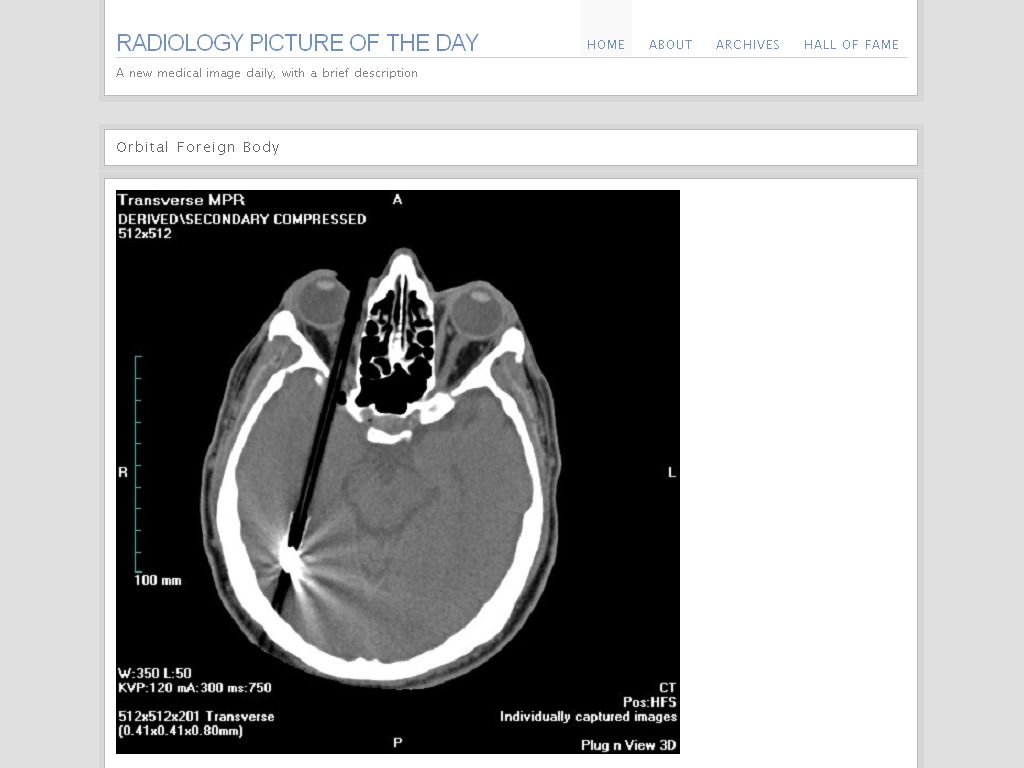 Radiology Picture of the Day features a new medical image daily, with a brief description. The website is edited and maintained by Dr. Laughlin Dawes who is a Radiology Registrar at Prince of Wales Hospital, Randwick. He lives in Sydney "with his wife Daniella, his sons Max and Alex, and Oscar the dog."
The website was started in 11/2006 and the Category Archives include:
Brain (10)
Cardiovascular (1)
Gastrointestinal (11)
Genitourinary (2)
Head & Neck (5)
Musculoskeletal (3)
Obstetrics (3)
Paediatrics (8)
Spine (2)
Thoracic (7)
There are more and more competitors to the famous NEJM Images in Clinical Medicine series...
References:
Link via Kevin, M.D.
NEJM RSS Feed for Image of the Week
Image source: Radiology Picture of the Day
Related:
More Consequences of IT: The Disappearance of Radiology Rounds. Wachter's World, 01/2008.
Updated: 01/31/2008
Sunday, November 5, 2006
DPP-4 Inhibitors for Treatment of Diabetes
Glucagon-like peptide-1 (GLP-1) is a GI peptide that stimulates insulin secretion (similar to sulfonylureas). GLP-1 also inhibits glucagon release, gastric emptying and food absorption. GLP-1 and another similar peptide are called incretins. As noted above, incretins have a dual action which leads to lowering blood glucose:
1. Stimulate insulin release
2. Inhibit glucagon release
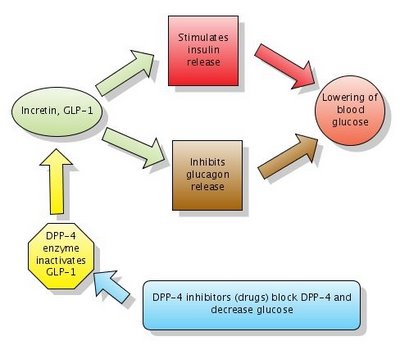
Figure 1. Action of DPP-4 inhibitors. Note that DPP-4 normally inactivates GLP-1. DPP-4 inhibitors block DPP-4 which in turn leaves GLP-1 active. Click to enlarge the figure. Created with Gliffy. The diagram Action of DPP-4 inhibitors is now on Wikipedia.
Exenatide (Byetta) is a GLP-1 receptor agonist approved for adjunctive therapy for patients with DM 2 who are not well controlled on oral agents. It is available only as injections and has to be administered twice daily.
Two new medications increase GLP-1 levels by blocking the enzyme which inactivates GLP-1. The enzymes is called DPP-4 (dipeptidyl peptidase-4) and the new medications are called DPP-4 inhibitors or gliptins.
They act similarly to Byetta (see figure above) but have the big advantage to be available in oral form (pills). These 2 new medications for treatment of DM2 are:
- Sitagliptin (Januvia) is taken once a day and it costs about $ 4.50 per pill
- Vildagliptin (Galvus) is waiting for FDA approval but it is already speculated to be at a competitive disadvantage to Januvia because it has to be taken twice a day
References:
New Medications
Merck Wins U.S. Approval for a New Diabetes Drug. NYTimes.
Sitagliptin: First DPP-4 Inhibitor for Type 2 Diabetes. Resident and Staff Physician, 04/2007.
Merck Diabetes Drug Could Face Competition from Takeda. WSJ Health Blog, 01/2008.
Related:
Lilly, Amylin Disclose More Cases of Byetta-Related Pancreatitis. WSJ Health Blog, 08/2008.
FDA Issues Warning for Diabetes Drug Byetta about possible kidney problems, including renal failure http://bit.ly/1UOjwB
Updated: 11/03/2009
1. Stimulate insulin release
2. Inhibit glucagon release
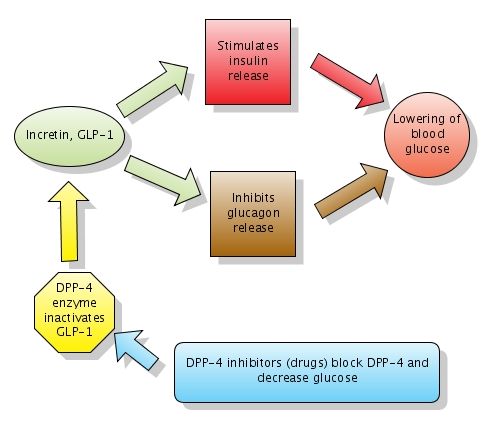
Figure 1. Action of DPP-4 inhibitors. Note that DPP-4 normally inactivates GLP-1. DPP-4 inhibitors block DPP-4 which in turn leaves GLP-1 active. Click to enlarge the figure. Created with Gliffy. The diagram Action of DPP-4 inhibitors is now on Wikipedia.

Exenatide (Byetta) is a GLP-1 receptor agonist approved for adjunctive therapy for patients with DM 2 who are not well controlled on oral agents. It is available only as injections and has to be administered twice daily.
Two new medications increase GLP-1 levels by blocking the enzyme which inactivates GLP-1. The enzymes is called DPP-4 (dipeptidyl peptidase-4) and the new medications are called DPP-4 inhibitors or gliptins.
They act similarly to Byetta (see figure above) but have the big advantage to be available in oral form (pills). These 2 new medications for treatment of DM2 are:
- Sitagliptin (Januvia) is taken once a day and it costs about $ 4.50 per pill
- Vildagliptin (Galvus) is waiting for FDA approval but it is already speculated to be at a competitive disadvantage to Januvia because it has to be taken twice a day
References:
New Medications
Merck Wins U.S. Approval for a New Diabetes Drug. NYTimes.
Sitagliptin: First DPP-4 Inhibitor for Type 2 Diabetes. Resident and Staff Physician, 04/2007.
Merck Diabetes Drug Could Face Competition from Takeda. WSJ Health Blog, 01/2008.
Related:
Lilly, Amylin Disclose More Cases of Byetta-Related Pancreatitis. WSJ Health Blog, 08/2008.
FDA Issues Warning for Diabetes Drug Byetta about possible kidney problems, including renal failure http://bit.ly/1UOjwB
Updated: 11/03/2009
Subscribe to:
Posts (Atom)