Showing posts with label Radiology. Show all posts

Wednesday, March 12, 2008

The Times with an X-ray gallery of common ski injuries

The winter is almost over but The Times of UK has just published an X-ray gallery of common ski injuries:

"If you are a skier, then the knee is the most likely injury on the slopes. And if you're a boarder? Do take care of your wrists, the most vulnerable to damage.

For skiers, the body parts most likely to be injured are the knee (32% of all ski injuries), head/face (13.7%), shoulder (9.1%), lower leg (7.6%), wrist (5.4%) and thumb (4.9%)"

References:
Ski breaks: the X-ray stories. The Times.
Image source: Bone fracture, from Wikipedia, the free encyclopedia (public domain).

Wednesday, January 30, 2008

Interesting Medical Websites

I you are interested in using the web for medical education, you can always rely on DavidRothman.net and ScienceRoll to find something useful.

A few examples are listed below:

- GoldMiner is a radiology search engine. I added it to the list of resources on ClinicalCases.org: Imaging: Electrocardiograms, X-rays, CT scans. Link via DavidRothman.net.

- FreeMD is "an electronic doctor that conducts an interview, analyzes symptoms, and provides expert advice — for free.” The website may not be an "electronic doctor" but is simple and easy to use. In my tests, the online diagnostic tool FreeMD worked well, and due to its extensive use of pre-recorded videos, it felt more interactive. Link via DavidRothman.net.

Related:
Performance of a Web-Based Clinical Diagnosis Support System for Internists. Mark L. Graber and Ashlei Mathew. J Gen Intern Med. 2008 January; 23(Suppl 1): 37–40.
Image source: Wikipedia

Friday, November 30, 2007

In the News: Serevent-related deaths and CT scans as a cause of cancer

Some FDA panel members recommend Serevent be taken off the market

Serevent, which is a part of the asthma blockbuster drug Advair, has been linked to sudden death in children. GSK claims there is no increased risk of hospitalization and mortality with Advair.

Serevent (salmeterol) is a long-acting beta2-adrenergic receptor agonist (LABA) which is used for treatment of asthma and COPD. The FDA will look into the safety profile of all LABAs at a future meeting.

Long acting beta-adrenoceptor agonists include salmeterol, formoterol (part of Symbicort) and bambuterol.

Note: The photo on the right shows a Seretide-labeled metered-dose inhaler (MDI). Seretide is the trademark for salmeterol in Europe.

CT scan may increase cancer risk

According to a NEJM review quoted in the NYTimes, in a few decades, 2 percent of cancers in the United States may be due to radiation from CT scans given now.

The average American’s total radiation exposure has doubled since 1980, largely because of CT scans. About 62 million of them were done in the U.S. in 2006 (up from three million in 1980) and studies suggest that a third of CT scans are unnecessary.

References:
Stronger Warnings Advised on Asthma Drug. NYTimes.
Report Links Increased Cancer Risk to CT Scans. NYTimes.
Current Concepts: Computed Tomography — An Increasing Source of Radiation Exposure. D. J. Brenner and E. J. Hall. NEJM.
Image source: Wikipedia, GNU Free Documentation License and public domain.

Thursday, June 28, 2007

What to do if you lose a guide wire during central line placement?

I was discussing central line placement complications with medical students a few days ago. Some of them are illustrated with horrifying details in the NEJM.

"What should you do if you lose a guide wire during central line placement?", I asked.

"We could use a strong magnet to pull it out", one of the students suggested.

Well, not really.

You should call interventional radiology immediately and the radiologist will extract the wire under fluoroscopic guidance by using another wire to hook up and pull out the lost one.

A few examples of different approaches to extract lost guide wires are listed in the British Journal of Anaesthesia.

We have published free illustrated step-by-step procedure guides to central placement with and without ultrasound. The guides are available as web pages and Windows Mobile/Palm downloads.

References:
Central Line Placement: A Step-by-Step Procedure Guide with Photos
Loss of the guide wire: mishap or blunder? British Journal of Anaesthesia, 2002, Vol. 88, No. 1 144-146.
Lost guide wire during central venous cannulation and its surgical retrieval. Kumar S, Eapen S, Vaid VN, Bhagwat AR. Indian J Surg 2006;68:33-34.
Image source: Wikipedia, public domain.

Further reading:
Lost Guide Wire. Radiology Picture of the Day.
A Big Time Mistake. Ten out of Ten: My experiences as an ER doc, 02/2008.
Improper placement of the central venous catheter - case one and case two from the Annals of Emergency Medicine

Updated: 02/09/2010

Wednesday, January 10, 2007

Something you have never seen before -- a rare central line complication in NEJM

A man had a central line inserted by a cardiologist through the left subclavian vein. Six months later, the patient presented with posterior neck pain. A guide wire was protruding from the back of his neck... Continue reading: Complication of Central Venous Catheterization. NEJM, 2007.

Our own images of central line complications simply pale in comparison to this NEJM case.

You can get more cases and images if you subscribe to the free NEJM image feed which is syndicated in the right sidebar of this web site: http://rss.nejm.org/imagecast.xml

References:
Complication of Central Venous Catheterization. NEJM, 2007.
Complications of Central Line Placement - Pneumothorax, Arrhythmia, Hematoma
Improper placement of the central venous catheter - case one and case two from the Annals of Emergency Medicine

Saturday, December 16, 2006

Radiology Picture of the Day

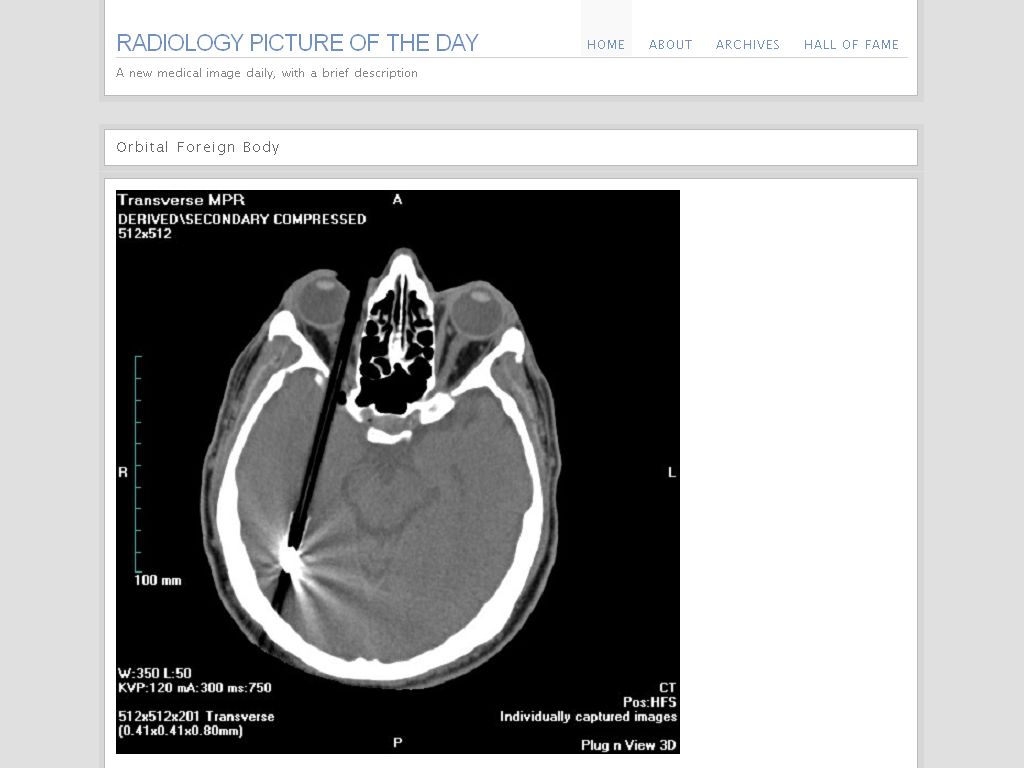
Radiology Picture of the Day features a new medical image daily, with a brief description. The website is edited and maintained by Dr. Laughlin Dawes who is a Radiology Registrar at Prince of Wales Hospital, Randwick. He lives in Sydney "with his wife Daniella, his sons Max and Alex, and Oscar the dog."

The website was started in 11/2006 and the Category Archives include:
Brain (10)
Cardiovascular (1)
Gastrointestinal (11)
Genitourinary (2)
Head & Neck (5)
Musculoskeletal (3)
Obstetrics (3)
Paediatrics (8)
Spine (2)
Thoracic (7)

There are more and more competitors to the famous NEJM Images in Clinical Medicine series...

References:
Link via Kevin, M.D.
NEJM RSS Feed for Image of the Week
Image source: Radiology Picture of the Day

Related:
More Consequences of IT: The Disappearance of Radiology Rounds. Wachter's World, 01/2008.

Updated: 01/31/2008