The CBS news anchor Katie Couric (formerly of the NBC Today show) lost her husband to colon cancer ten years ago. According to the press release, "since then colon cancer awareness and prevention has been a cause near to her heart. March is Colon Cancer Awareness Month and Katie Couric put together a video for her YouTube channel with recognizable faces who have loaned their talent for Public Service Announcements about the disease."
"Randy Pausch is a 46-year-old computer science professor who has incurable pancreatic cancer. It's not that he's in denial about the fact that he only has months to live, he told the 400 listeners packed into McConomy Auditorium on the campus, and the hundreds more listening to a live Web cast."
WSJ video
After months of experimental chemotherapy at M. D. Anderson Cancer Center, Dr. Pausch had one of the most aggressive recurrences his doctors have ever seen and reportedly has only a few months to live.
"With his oldest son, 5-year-old Dylan, Dr. Pausch went on a recent trip to Disney World and to swim with dolphins, thinking Dylan may be the only child who will have strong direct memories of him."
"If I don't seem as depressed or morose as I should be, sorry to disappoint you," he said during his lecture.
Luciano Pavarotti, the most famous opera singer of our age, died at 71 of pancreatic cancer. The CNN headline "Heaven Now Has a Tenor" reflects the great admiration millions have for the singer.
Listen to the NPR coverage along with their choice of 7 Pavarotti recordings you must hear. During a tenor's high C, his vocal folds close 500 times a second; for a soprano's high C, the rate is about 1,300 times each second (source: Slate.com).
Luciano Pavarotti Sings Ave Maria by Schubert
According to Wikipedia, "Pavarotti was diagnosed with pancreatic cancer in July 2006 and required emergency surgery to remove the tumor. Shortly after surgery he was reported to be "recovering well." On Thursday, August 9, 2007, he was hospitalized for observation in his hometown of Modena, in Northern Italy. On August 21, it was announced that he was being treated in the cancer ward, given tests related to his pancreatic cancer, and would not be released for another few days. On September 5, 2007, Italy's AGI news agency reported that Luciano Pavarotti's health had deteriorated and the 71-year-old singer was in a "very serious condition". He was reported to be in and out of consciousness multiple times, suffering kidney failure. Luciano Pavarotti died the morning of September 6, 2007 at home in Modena, Italy where he was surrounded by his wife, sister, and four older daughters. In an email statement, his manager, Terri Robson, wrote, "The Maestro fought a long, tough battle against the pancreatic cancer which eventually took his life. In fitting with the approach that characterized his life and work, he remained positive until finally succumbing to the last stages of his illness."
"Be Prepared With Tissues" … was the only warning our classmate gave when he just sent this out to our class listserv. I had no idea I could be so moved to tears within the span of about 2 minutes."
Being a doctor sometimes feels like the most difficult job in the world.
We fret over the most minute details of our lives, stressing over critical decisions (plasma or LCD for that HDTV? Italian or Asian for that weekend dinner?) while Fate's kindest or cruelest blows are utterly beyond our vision or control.
Nowhere is that more dramatically shown than in the world of politics.
Who gets to ride with the candidate from the plane to the reception; who stands behind her? What food gets served at the fundraiser? Are the pamphlets printed in a union shop on recycled paper?
And then Fate steps in -- and reminds us of one of life's most ineluctable truths.
The Edwards family has had more than its share of hammer blows, from the death of a son in a car crash, to Elizabeth's breast cancer diagnosis that came in the weeks before the election loss in 2004."
In the press reports, metastatic bone cancer has been compared to a chronic disease like diabetes, but many doctors will have doubts about that description, I think.
As it is becoming customary now, medical blogosphere provides a very good (and naturally, professional) coverage of medical conditions affecting well-known people. For example:
- Kevin commented on the initial diagnosis of Elizabeth Edwards' breast cancer in 2004.
- Respectful Insolence: Elizabeth Edwards and bone metastases from breast cancer
Stage IV breast cancer is a much more serious diagnosis than an episode of DVT (without PE). I join Kevin in wishing Elizabeth Edwards and her family all the best during this difficult time.
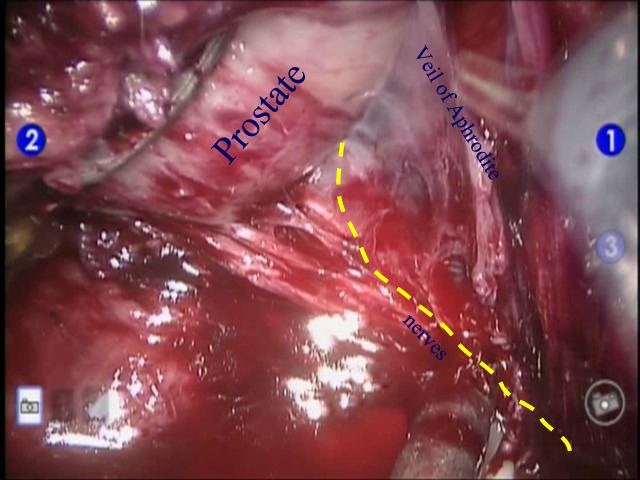
"This post is for all the men who have prostate cancer or are worried about prostate cancer. One of the most feared side effects of therapy for prostate cancer is the impact on sexual health.
Hopefully this will give men a better idea of what to expect and take some of the fear of the unknown away."
The post also includes a video demonstrating a nerve-sparing prostatectomy via the da Vinci robot (picture above).
Role of PDE-5 inhibitors (Viagra, Cialis, etc.)
According to Oxford Bandolier Journal, "recovery of sexual function after prostatectomy is not immediate, and it can take up to 2 years for full recovery even after nerve sparing surgery. Oral PDE-5 inhibitors are usually the first line therapy, with reported efficacy in 10-80% of men after nerve sparing surgery, but probably below 15% after non-nerve sparing surgery."