Tuesday, October 31, 2006

UBC Google Scholar Blog is Going on Hiatus

UBC Academic Search - Google Scholar Blog was the place to go for updates and insights on how medical librarians, physicians and patients are using search engines to sort out the staggering amount of information on the web. Now, Dean Giustini, the blog author is putting the site on hiatus for at least a year:

UBC Google scholar blog is going on hiatus. Well, let's just call it a sabbatical. As of January 2007, a sign will go up saying Gone fishing - see you in 2008. I am going to be immersing myself in learning theory for my 2007 sabbatical, and that means I won't be tracking trends in search. What will happen to GS blog? What about the wiki? All good questions.

I am pondering what to do next. Will I return here? Time will tell.

Last December, Dean wrote an interesting editorial for BMJ: How Google is changing medicine. He also interviewed several physician bloggers (including me) a few months ago.

I am not the only one waiting for Dean to start blogging again and that's why I will stay subscribed in Bloglines.

Update 01/29/2008:

Dean is blogging again.

References:
Physician Bloggers Talk to a Medical Librarian
BMJ: Build Google Medicine
Image source: UBC Academic Search - Google Scholar Blog

Updated: 01/29/2008

Monday, October 30, 2006

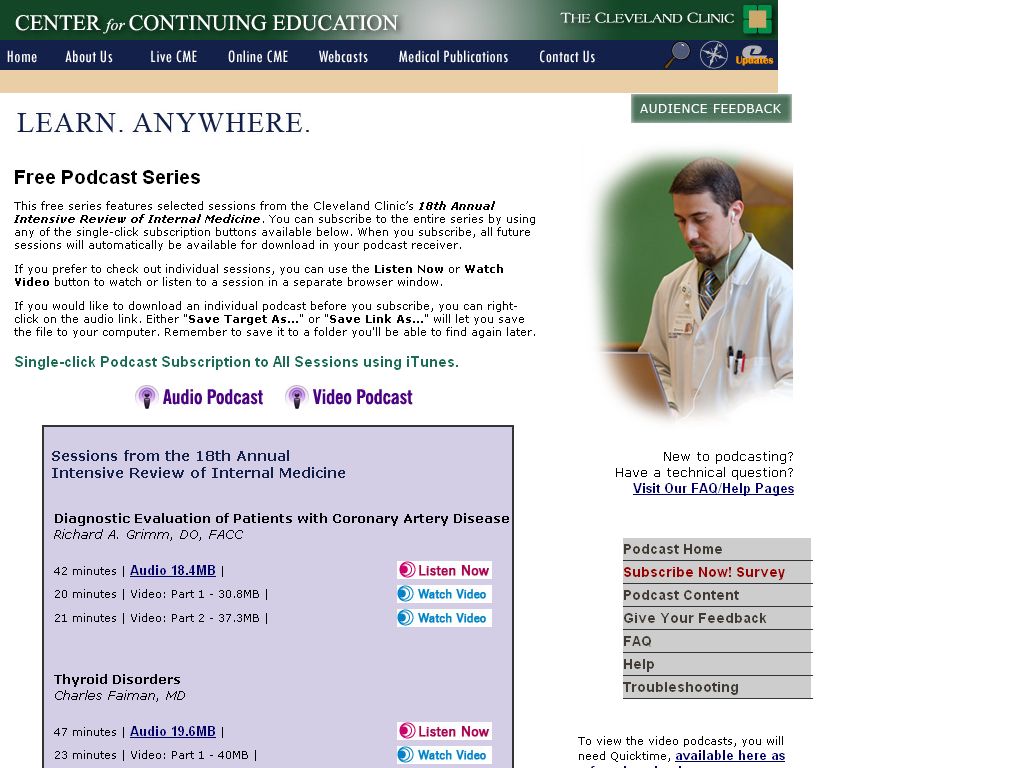
Free Audio and Video Podcasts for Health Professionals by Cleveland Clinic

Several months ago, Cleveland Clinic launched a video podcast for patients called HealthEdge. The next logical step was to have a similar service for health professionals.

Cleveland Clinic Center for Continuous Medical Educations now features free audio and video podcasts. The series starts with the Sessions from the 18th Annual Intensive Review of Internal Medicine. You can either listen/view podcasts online or subscribe with iTunes.

References:
Video Podcasts by The Cleveland Clinic
Cleveland Clinic Health Edge on Google Video
Cleveland Clinic Offers New Podcasts
Image source: Cleveland Clinic

Sunday, October 29, 2006

RSS "Feeds That Matter"

So many feeds to read, so little time... Which are the good ones? There is a "proof-of-concept" website which helps you quickly browse the feeds which many people have already chosen.

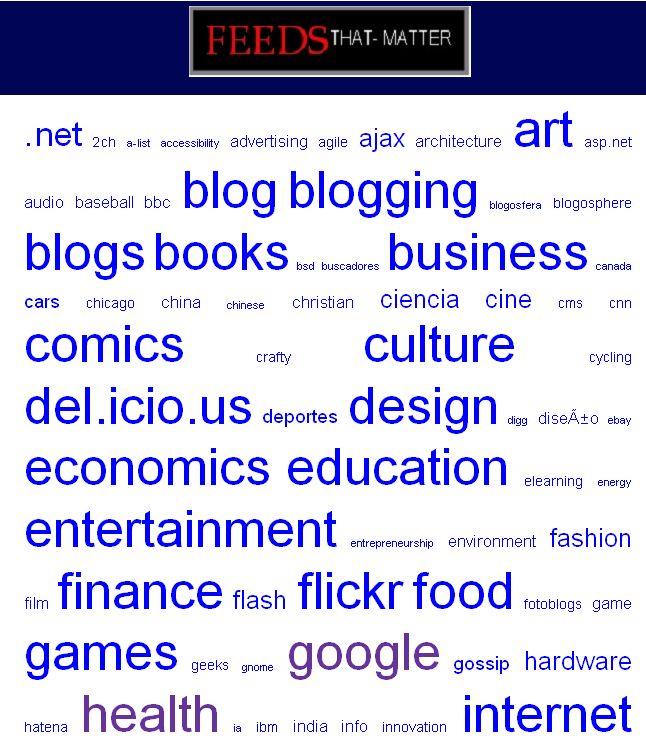
Feeds That Matter is a tag cloud which lists the top 100 most popular RSS feeds by topic, for example, "health", "Google", "business", etc.

The tag cloud combines data from Bloglines users who chose to make their subscription choices public:

"There are about 83,000 publicly listed users on Bloglines and they have a combined 2,786,687 feed subscriptions. Roughly 35% of these publicly listed users organize their feeds into folders. On an average there are about 20 feeds per folder. By analyzing this data and combining merging folders that are very similar, we have come up with an automatic way of creating a taxonomy of popular topics and make it easy to find feeds that are most relevant to that topic."

Established media (Reuters, BBC, NYTimes, ABC) tops the list of the most popular "health" feeds but quite a few blogs are also present: Kevin, MD, Medpundit, The Health Care Blog, etc. Clinical Cases and Images - Blog (barely) makes the top 100 list at number 88. My blog rating jumps to number 15 in the list of medical feeds though. You can check your own blog rating, just for the fun of it.

Link via LifeHacker.com.

Friday, October 27, 2006

Should we use ACEi or ARBs for prevention of renal failure in patients with hypertension or diabetes?

Diabetes mellitus (DM) and hypertension (HTN) increase the risk for development of chronic kidney disease (CKD). Type 2 diabetes (DM 2) is the biggest single cause of ESRD in the United States which is reflected in the mnemonic for differential diagnosis of CKD.

Should we use ACE inhibitors (ACEi) or Angiotensin II Receptor Blockers (ARBs) for prevention of CKD in patients with HTN and/or DM?

According to UpToDate (subscription required):

ARBs have similar antiproteinuric activity as ACEi but it should not be assumed that ARBs are equivalent to ACEi. A medication from either group should be used in proteinuric nondiabetic kidney disease, although the strength of evidence favors the use of an ACEi.

Summary: ACEi is the medication of choice to prevent progression of CKD in HTN.

How about patients with DM?

Again, according to another UpToDate review:

The authors prefer initiating therapy with ACEi inhibitor in DM 1 nephropathy and either ACEi or ARBs in DM2 nephropathy.

Summary: Either ACEi or ARB can be used to prevent progression of CKD in DM 2. I would still prefer ACEi since they have been on the market longer and are generally less expensive due to the fact that generics are available.

References:
Prevention of the Development and Progression of Renal Disease. J Am Soc Nephrol 14:S144-S147, 2003 (free full text).
Antihypertensive therapy and progression of chronic kidney disease. UpToDate (subscription required).
Treatment and prevention of diabetic nephropathy. UpToDate (subscription required).
ACEi and ARBs links and images are from Wikipedia.

Friday, October 20, 2006

Executive Health Physicals. Are They Worth $ 3,000?

According to Forbes: "A sick CEO is bad for the company's health... executives who had a physical exam lost 45% fewer workdays than those who did not... generally executive health physicals cost between $1,000 and $3,000."

Cleveland Clinic, Mayo Clinic, Duke University and Mount Sinai all have executive health programs. I know personally 2 of the physicians who work in the Clinic program and they are excellent.


What you can expect on during your Executive Health Assessment - Cleveland Clinic video.

References:
Not So Routine Physicals. Forbes.com.
Welcome to Executive Health. Cleveland Clinic.com.

Wednesday, October 18, 2006

Complete List of Medical Abbreviations and Acronyms

"He had CP and SOB, was diagnosed w NSTEMI, had a PCI and is now in MICU."

Whether you like or not, medical jargon is part of health care. Years ago, before I started my clinical rotations, I assembled a comprehensive list of all medical abbreviations I could find and memorized them by heart. It may sound strange but I actually liked using them. Also, for a short while, I was known as the "mnemonics guy" since (due to lack of other ideas how to better spend my time) I had made up about 800 mnemonics. Abbreviations and acronyms are sort of mnemonics, they save time and... create confusion. Pretty much everybody who works in health care knows CHF and COPD but how about AOCD (anemia of chronic disease)?

When I started ClinicalCases.org (an online case-based curriculum of clinical medicine), I deliberately decided to use a lot of abbreviations. Why? Because this is how the real medicine looks like in patient charts. You have to know that "WNL" means within normal limits, otherwise you may never figure out what the note is about. Now, with EHR (electronic health records) and medical coding, the art of medical acronyms may come to an end. Computer-generated notes (with some human input) are infamously verbose, often with amazingly little substance. Who needs to write "WD/WN in NAD" when the computer lavishly puts "well-developed and well-nourished in no apparent distress"?

Every now and then, international readers of ClinicalCases.org ask what the different abbreviations in case descriptions mean. This is a link to a very detailed Wikipedia page which lists almost every medical acronym and abbreviation known to human kind. And the beauty of the wiki system is that if you find one which is not listed there, you can add it yourself.

Don't forget to check the difference between acronyms and abbreviations. For starters, all acronyms are abbreviations, but not all abbreviations are acronyms.... :-)

References:

A Comprehensive List of Medical Abbreviations http://goo.gl/0wW0R and  http://goo.gl/DQvEM
List of medical abbreviations, from Wikipedia, the free encyclopedia.
Translating the medical chart. KevinMD/blog.
Online Resources for Medical Abbreviations. DavidRothman.net.
Medical Mnemonics
100% of Greek philosopher named trials showed reduction in mortality, compared with 12% of trials with other acronyms. Lancet, 2011.
Image source: Openclipart.org

Tuesday, October 17, 2006

EmergiBlog Advice: So You Want to Host Grand Rounds?

EmergiBlog has some useful advice for future hosts of the venerable and well-respected Grand Rounds, the weekly collection of the best posts in medical blogosphere.

Coincidentally (or not), Kim of Emergiblog is this week's host after a 12-hour ER shift. It's amazing what sleep deprivation and caffeine can do to normally sane people. It can even lead them to assemble a 7-point checklist of things to do when you host Grand Rounds... :-)

Grand Rounds has become the contemporary weekly portrait of medicine through the eyes of the medical bloggers.

Pre-Rounds is an article series about the hosts of Grand Rounds on Medscape.com. Nick Genes of Blogborygmi, who writes the Medscape column, is the founder of GR and the archive host.